

Unmasked Month: The Stepfather Trilogy (1987-1992)
When is a mask not a mask? When you aren’t actually wearing one but still no one can tell who – or what – you really are. In the Stepfather trilogy, it’s when a man appears on the face of things to be a loving father, but beneath the facade turns out to be a psychotic serial killer willing to resort to any lengths to maintain his “perfect” family life.
Like the mask itself, it’s all an illusion, of course. The Stepfather (who goes by various names throughout the series, and is played first by Terry O’Quinn, then Robert Wightman) is in love with the idea of being the patriarch of a perfect nuclear family, but never really loves the other members of the family at all. They’re all interchangeable – merely supporting actors to be hired and fired as necessary. Except getting fired by the Stepfather usually means ending up as a bloody mess on the lovely new carpet when disappointed Daddy decides it’s time to move on to a new family.
Back in the late Eighties and early Nineties, when the Stepfather movies were in their heyday, the series (and particularly the well-received original) were seen by critics as a comment on the outdated unfeasibility of traditional family values. At a time when President Bush was asking Americans to be “more like the Waltons and less like the Simpsons”, people asked “What’s so wrong with the Simpsons?” and cheered The Stepfather’s portrayal of the nuclear family facing meltdown.
Twenty-odd years later, in a reality TV-infused, celebrity-endorsed culture that plays like a parody of a parody of family values, the trilogy reads more like a satire of quickie divorces and disposable lifestyles, with everyone getting their fifteen minutes of fame before the Stepfather changes the channel and murders his way out. As the series gets more outlandish, it moves more into the territory of what was at the time the gruesome granddaddy of bombastic media satires, 1994’s Natural Born Killers, with its murderous married couple dispatching all those who get between them and their pursuit of the American Dream.
Indeed, watching the Stepfather movies back-to-back is a bit of a mind-fuck in itself. All three films are monstrous teases, stretching the sense of suspense and anticipation to breaking-point before unleashing their violent climaxes. All three are also incredibly repetitive – which isn’t a criticism you can level at the first film, obviously, but when multiplied by three has your head spinning, trying to remember not only which film is which, but which family is which (a problem that eventually rears its head for the Stepfather himself, as we’ll see in a moment). How do the movies stack up today against an overstuffed backdrop of competing retro-slashers? Let’s find out!

Released in early 1987, The Stepfather anticipated a wave of slasher-inspired “cuckoo in the nest” thrillers wherein couples, families and even work colleagues faced threats to their stability, often from within. The same year’s subsequent Fatal Attraction was the one that caught the public imagination – but also one that proved the most reactionary (you can have an affair as long as you’re a man, it seems to say, but don’t let the wife find out, and remember that family comes first). The Stepfather opens with Jerry Blake (O’Quinn) having already chopped up one family and setting out to find a newer model – a theme that returns again and again (and again) throughout the series. In something of a casting coup, he ends up with an actual model in Shelley Hack (also fresh from horror-movie mom duties in Troll) as beautiful bride-to-be, and much-loved minor scream queen Jill Schoelen as his prospective stepdaughter. His job as a realtor allows him to populate the surrounding neighbourhood with just the right sort of friendly folk to complement his domestic bliss.
From here on in, it’s all an enormous tease, as we’ve already noted: we know the pretty picture can’t last, the blots on the canvas will spread, and the Stepfather’s invisible mask will eventually slip. And slip it does – in spectacular fashion. Thanks to O’Quinn’s brilliant performance, the moment when he reveals his true colours to his wife is probably the high point of the entire series – a truly terrifying reveal preceded by the memorable “Who am I here?” line that justifiably made it onto the front cover of the most recent DVD release.
Other carefully-judged elements make The Stepfather more than an exercise in empty suspense. Schoelen’s problem teen is believably etched and refreshingly not the squeaky-clean character it would’ve been easy to install in the role. Furthermore, she knows she’s a liability to the familial idyll – and knows there’s something wrong even before she can put her finger on it. There’s also a nice playoff between the rosy suburban setting of the central family home and the wider Washington state backdrop of stark cityscapes, rugged shorelines and the Stepfather’s abandoned former house that flavour the film’s various subplots (one of which, like The Shining, involves someone in the know gradually edging towards the rescue). Even the potentially corny “snooping psychiatrist” storyline pays off with an agonizingly taut sequence, turning from a verbal chess-game between Stepfather and foe into a confrontation which is, shall we say, more physical.
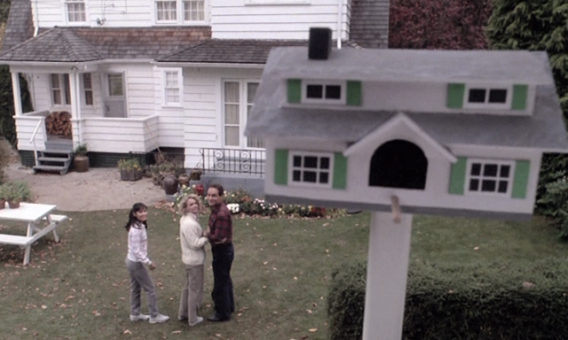
Beyond the broader strokes, touches like the Stepfather building a little birdhouse in the back garden or giggling along with an old episode of Mister Ed on TV almost evoke sympathy for him, although deep down you know it’s just director Joseph Ruben gilding the glass in order to make the most satisfying smash. It’s the affecting moments like these, however, that give the movie its resonance and staying-power, anchoring it in the cultural mindset long enough to merit the inevitable new-millennium remake in 2009… although it’s arguable that it had already been remade twice, beginning twenty years prior with Stepfather II.

Clearly more tongue-in-cheek from the outset (it’s even subtitled “Make Room for Daddy”), 1989’s Stepfather II takes everything that was successful about the original and, well, does it again, throwing a bit more blood and a lot more silliness in to the mix. Luckily, the cultish cast is as good, if not better, than before, bringing in the always enjoyably offbeat Meg Foster as the latest marriage material, the intriguing, ill-fated Jonathan Brandis as would-be stepson and, in a touch likely to please all slasher-fans, Texas Chainsaw 2’s wonderful Caroline Williams as the suspicious local snooper obviously heading for a sticky end.
In order to follow the only slightly-open ending of the first film – not to mention increase the bodycount – the Stepfather must first break out of an asylum before beginning his search for a new family. Hilariously, he then sets himself up as a marriage counsellor for frustrated wives, going by the new name of Dr Gene Clifford. Cue more sly digs at suburban life, more murders, and a hell of a lot of late-80s knitwear, all of which climaxes at a wedding chapel with the expected burst of cathartic violence and, naturally, a slow-motion shot of the little bride and groom falling from the top of a wedding cake and symbolically smashing to pieces on the floor.
All in all, then, you couldn’t ask for a much better sequel. Where you lose the serious tone that made the original so effective, you get a pastel-toned cartoon nightmare that turns the controlled-frustration theme to its advantage by playing it partly for quirky laughs. Thankfully, these never spill over into outright comedy, and Stepfather II always comes down on the side of the horror when it comes to the crunch, splat or stab. Although O’Quinn is again the ringmaster the movie needs, it’s not just about him in the way a later Elm Street sequel is all about the Freddy; it’s a proper performance, and O’Quinn is always a fascinating, frighteningly loose cannon, rather than a showboating slasher-villain.

Daddy’s back for a hat-trick (and, if that wasn’t the tagline, it should’ve been) in 1992’s Stepfather III, which was intended to go straight to video but ended up premiering on HBO instead. Terry O’Quinn has sadly but sensibly departed the series, his character having undergone plastic surgery to emerge in the guise of a suitably plasticky-looking Robert Wightman – an actor who, in a stroke of irony so pungent you can practically taste it, is probably best-known for playing John-Boy in later seasons of The Waltons. In a doubly amusing touch, once the genuinely unsettling, anaesthetic-free surgery sequence is over, we still don’t get a proper look at Wightman even after he’s arrived in suburbia in search of fresh blood, due to the fact that he’s all dressed up as the Easter Bunny for a local church party. This also gives Stepfather III the distinction of being the only horror film I can think of, other than Critters 2, with an Easter backdrop – unless you count The Passion of the Christ.
Anyway, the freakishly fake-seeming Wightman is a welcome enough addition, and rings a change that the series probably needed. Not that he’s better in the role than O’Quinn… Who could be? But dragging O’Quinn back again would surely have damaged his career, and thus probably sullied the franchise’s reputation even more than a simple bad sequel. Thankfully, Stepfather III isn’t a bad sequel – just a little more blunt in its determination to get the job done. Even the Stepfather himself has gone blue-collar this time, working as a gardener presumably just to give himself somewhere to bury the bodies.
Were it not for the fact that it rips off major plot points from the original, however, you’d almost think that the makers had only ever seen part two. The Stepfather (calling himself Keith Grant) is now apparently only interested in women with twelve-year-old sons, going after not one but two potential wives, and thus bringing in a bigamy subplot that sits nicely with the expected, more-is-more excesses of a second sequel. One nice touch is that this chapter’s obvious kill-fodder character – a meddling local priest – is, in a wry counterpoint, regularly also referred to as “Father”.
Yet again, the casting is killer. Making real the sitcom-perfection theme, wife #4 (or is it 5, 6 or more?) is played by Three’s Company’s Priscilla Barnes, a perfect match for Wightman, being equally stiff, wide-eyed, and hilarious. The sleuthing, crime-obsessed son (played by David Tom) is stuffed into a wheelchair for the sole purpose of engineering a suspenseful “I can walk again!” climax (because all disabilities are psychosomatic, don’t you know?). And, speaking of the finale, it’s a frantic, borderline-surreal affair involving a gruesomely-utilized wood-chipper, which takes place on Father’s Day in that bastion of fatherly wholesomeness – the garden centre. It’s pretty camp, but it’s good camp… meaning it’s actually just a little bit bad… all of which makes it pretty good fun again.
One thing – unusual for both the time of its release and when measured against today’s even more cannibalistic takes on franchise horror – is that Stepfather III reaches a pretty unambiguous conclusion. There’s not much room for coming back, which is perhaps why the series ended after producing a small, if not quite perfectly formed, then perfectly acceptable trilogy. (2009’s The Stepfather got around the problem by simply being a straight-up remake – but, as a watered-down carbon-copy touting only a commercially-viable PG-13 rating and roster of good-looking TV stars, it’s one of the most pointless ever put into production.)
I’d argue that Stepfathers I-III do in fact constitute a real, if repetitive, trilogy, as opposed to being three films with the same plot. There’s a gradual escalation of insanity throughout the three, as the Stepfather’s grip on reality gets ever less rational and more desperate. By the third, he’s having an affair, covering for the boss he’s killed, and wearing a fake face (a literal “mask” for the first time). There’s also continuity in his obsessions: making model houses – perfect, manageable nutshells of the life he craves – and coaching children in the hobbies he thinks beneficial, suggesting problems with his own childhood. Taken as a trilogy, there’s a noticeable decline in quality, perhaps, but even the silliest detours remain true to the psychotic logic of its unforgettable central character.
Don’t watch the Stepfather trilogy expecting something as coherent in tone and execution as the Godfather trilogy, then. But, for a mixture of high tension, deranged giggles, and the occasional flicker of genuinely disturbing malice, it’s the perfect family night in.


 Call me creepy, but films about obsessed fans that predate the semi-new celebrity stalking trend fascinate me. They can be outrageously over the top, such as



Comments